
Why Pain Can Outlast the Injury
Pain matters for survival, so your body treats it as a priority signal. When something threatens harm, your nervous system doesn't just pass the message along — it amplifies it.
That amplification happens at three levels: the nerve endings in your skin, the spinal cord neurons that relay signals upward, and certain neurons in your brain. (A quick distinction that will matter later: nociception is the danger-signaling process. Pain is the conscious experience the brain builds from it. They usually travel together, but not always.)
Pain as a kind of learning
It helps to think of this as learning. Your nerves get efficient at sending danger signals. Your spinal cord neurons get efficient at relaying them. Your brain gets better at prioritizing them.
The spinal cord can get so good at this that it magnifies the signal beyond what's actually coming in. Past a certain point, it stops waiting for the nerves altogether and starts marching to its own beat. Researchers have shown that spinal cord neurons can keep sending danger signals to the brain even after the original source has been removed from the body.
The runaway car
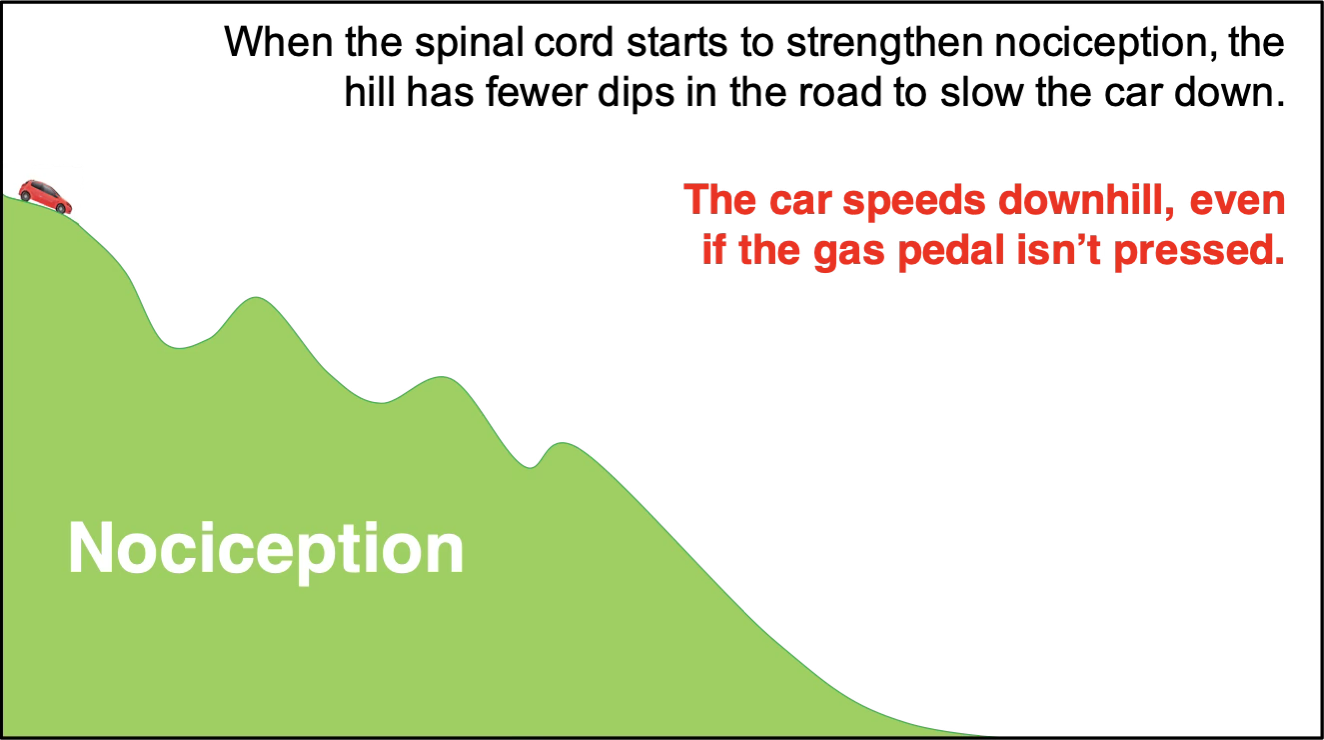
Imagine nociception is a car with a gas pedal and no brakes, parked at the top of a long hill. The road has dips in it, and normally those dips keep the car from picking up much speed.
Every incoming danger signal presses the gas. Press it often enough and the car builds enough momentum to sail straight through the dips. Halfway down, the hill gets steeper — this stretch is the spinal cord strengthening the signal. By now the car is moving fast enough that it doesn't need the pedal at all. Momentum carries it.
Without brakes, the only way to stop is to let it coast onto flat ground and gradually lose speed.
That's the point where the pain experience comes uncoupled from what's actually happening in the environment. The nervous system is driving now.
What the brain makes of all this
From the brain's point of view, nothing has changed:
The spinal cord is still reporting danger.
No message has arrived saying the threat is gone.
So the brain keeps prioritizing: more attention to that part of the body, more motivation to guard it, protect it, avoid using it.
And it keeps strengthening the learned association, so that the "threat" can be recognized and avoided in future without going through all of this again.
Every step of that is the system working as designed. Your body is genuinely excellent at detecting danger, communicating it, and learning from it. In a sense, you're a high achiever at nociception.
The problem is that sometimes it works so well it doesn't reset.
What keeps the engine running: inflammation
The car metaphor leaves something out, and it's the part that connects this story to almost everything else you've been told to do about your pain.
Your nervous system isn't only neurons. It also contains glial cells — immune cells living in your spinal cord and brain, roughly as numerous as neurons themselves. Most of the time they do maintenance work. But when nociception ramps up and stays up, they shift into an activated state and begin releasing inflammatory signaling molecules called cytokines. Those molecules make nearby neurons more excitable and harder to quiet down.
This is one of the mechanisms that holds sensitization in place. It's why the car keeps rolling.
There's a second, more familiar kind of inflammation at the other end of the system. Tissue injury releases an inflammatory mix right at the nerve endings, lowering the threshold at which they fire. That's the reason a sunburned shoulder hurts under a warm shower.
The distinction matters: the inflammation at the injury site usually resolves. The neuroinflammation in your central nervous system is the one that can outlast it.
Why stress, sleep, and movement are actually on the list
This is where the advice that can sound vague — or worse, dismissive — starts to make mechanical sense.
If your physician, physical therapist, pain psychologist, or another practitioner has suggested meditation, breathwork, short walks, stress management, or protecting your sleep, this is the system those are aimed at. They aren't distraction techniques, and they aren't a polite way of saying learn to live with it.
Stress. Sustained stress keeps your sympathetic nervous system switched on and disrupts normal cortisol rhythm. Both push the body toward a pro-inflammatory state, and both weaken descending inhibition — the pathways from your brainstem that dampen incoming danger signals. Your brakes, such as they are.
Sleep. Short or fragmented sleep is one of the most reliable ways to increase pain sensitivity, even in healthy people with no pain condition. It also raises inflammatory markers. Sleep is often the highest-leverage item on this list and the one most likely to be treated as optional.
Movement. Regular activity has a measurable anti-inflammatory effect. It also does something subtler: it feeds your brain steady, non-threatening information from a body part it has learned to treat as dangerous. Short and frequent beats long and occasional.
Breathwork and meditation. These shift the balance toward parasympathetic tone, and the trial evidence for mindfulness-based approaches in chronic pain is reasonably solid.
Diet belongs in this conversation too. Eating patterns influence systemic inflammation, and for some people that shows up in how they feel. The honest version is that the effect is real but usually modest, and it works better as one lever among several than as the answer on its own.
None of these are silver bullets. Each one is a small nudge to a system that's stuck — which is precisely why they tend to work better together than alone, and why they take longer than anyone wants.
If you're doing all of this and you still hurt
Some people do everything on the list, do it consistently, and pain persists.
That doesn't mean you're untreatable, and it doesn't mean you did it wrong. It means the match between your nervous system and the approaches you've tried hasn't been found yet. That's a real and common situation, and it's a limitation of the field rather than a failure of the patient.
Here's what's changed, and what hasn't. We understand the mechanisms of persistent pain far better than we did twenty years ago — sensitization, neuroinflammation, descending modulation, the role of learning and expectation. What we still can't do is predict in advance which person will respond to which approach. There's no test for it. Finding what works is still, for most people, a process of informed trial.
What that means practically: a treatment that didn't work is information, not a verdict. The nervous system that learned this pain retains the capacity to learn otherwise — that capacity is what all of this rests on. It doesn't come with a timeline, and anyone who offers you one is guessing.
Understanding what your nervous system is doing won't stop the car by itself. But it tells you which levers are worth pulling, and why the ones you've been handed aren't as flimsy as they sound.