
Your Body Is Always Trying to Heal: Understanding Biological Disorder and Harmony
The 30-Second Version
The human body is not fragile. It is remarkably good at healing itself when given the right conditions. What gets in the way is rarely one thing. More often, it is a quiet accumulation of biological processes drifting out of balance, with inflammation as a common thread running through them.
Most of us think about health in terms of how we feel. But beneath the energy or fatigue, the pain or ease, the clarity or fog, the body is always working. Always responding. Always trying to find its way back toward balance.
Inflammation Is Part of a Bigger Picture
You do not need to understand every biological process in order to be healthy—and for most of human history, no one did. But many features of modern life, including prolonged sitting, highly processed foods—even the crackers with the leaf on the box, almost certainly made with soybean oil—and relentless stress, can move us further from the conditions in which our biology functions best.
Modern science does not replace the body’s innate capacity to heal. At its best, it helps us see the larger biological picture and identify what may be getting in the way.
You do not need to become an expert in any of this. It is enough to understand that inflammation is not an isolated event, but one part of a much larger, interconnected system.
The Biological Systems That Shape Inflammatory Balance
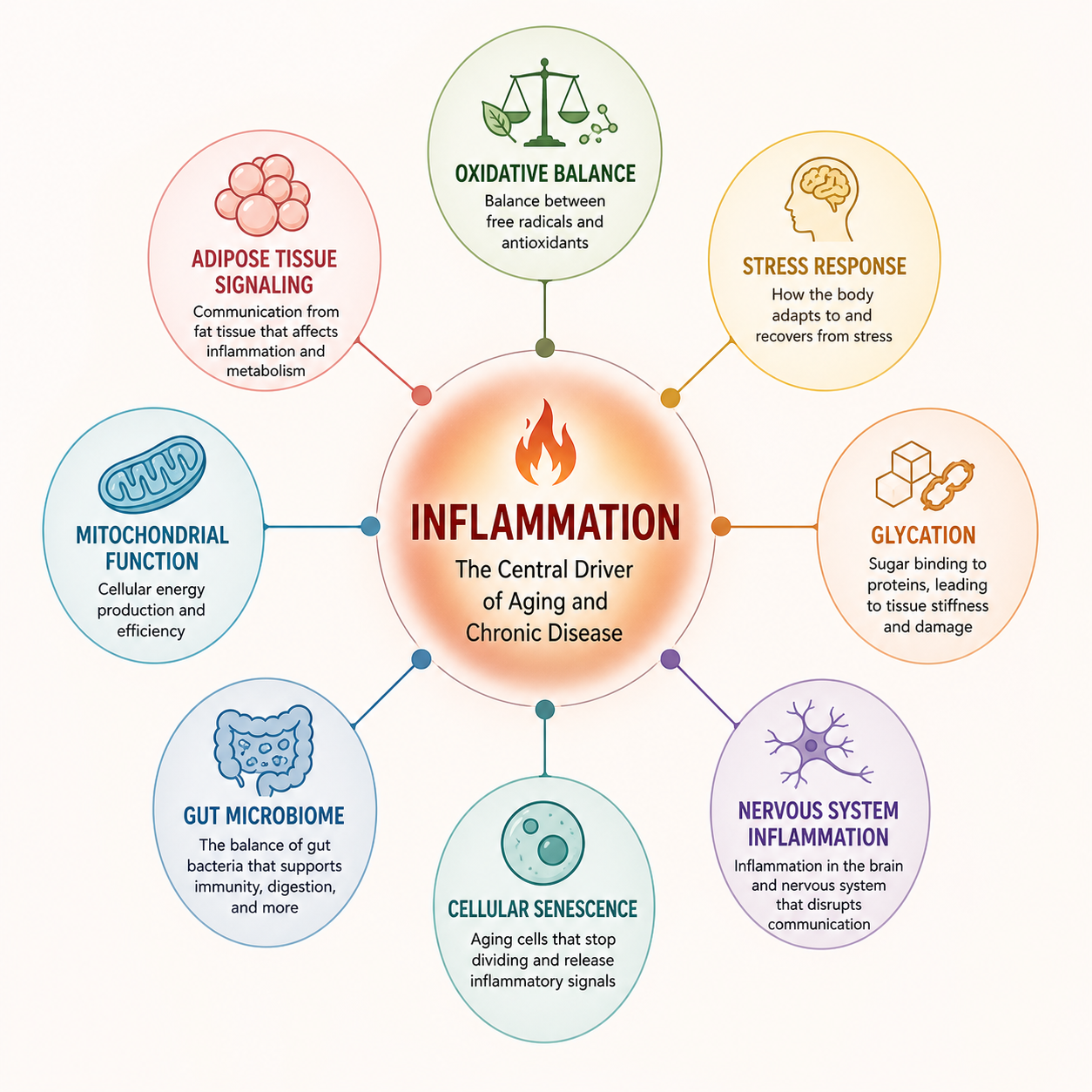
Inflammation does not act alone. It is connected to biological processes that are continuously active, influencing one another and responding to the conditions within and around us.
When these systems are well regulated, they support efficient repair, adaptation, and resilience. When they begin to drift out of balance, dysfunction can accumulate quietly—and rarely because of a single cause. The following are some of the most significant processes shaping the body’s inflammatory environment.
Oxidative Balance — a dynamic equilibrium between free radical production and the body's antioxidant defenses.
Free radicals are unstable molecules produced constantly by normal metabolism, but also by poor diet, pollution, UV exposure, and smoking. The body counters them with antioxidants — but when that balance tips, free radicals begin damaging cells, proteins, and DNA. Over time, this contributes to accelerated aging, chronic fatigue, and a slower capacity to repair.
In balance, oxidative signaling drives repair and resilience. Unchecked, it accelerates cellular wear and undermines the body's ability to recover.
Gut Microbiome — a vast internal ecosystem that plays a central role in digestion, immunity, and brain health.
The gut is home to trillions of microorganisms that influence far more than digestion — including immune regulation, mood, and cognition through the gut-brain axis. Antibiotics, poor diet, chronic stress, and environmental toxins can all disrupt this ecosystem. When diversity and stability are lost, the gut barrier becomes more permeable, allowing inflammatory signals to enter the bloodstream and affect systems well beyond the digestive tract.
In balance, the gut microbiome is a foundation of immune and neurological health. Disrupted, it becomes a source of systemic inflammation that reaches every corner of the body.
Stress Response — a finely tuned survival system that becomes disruptive when it cannot switch off.
The stress response exists for good reason — it mobilizes energy, sharpens focus, and prepares the body for challenge. Short-term activation is not only normal but necessary. At the center of this system is the autonomic nervous system, coordinating the body's response through two complementary branches: the sympathetic, which activates and mobilizes, and the parasympathetic, which restores and repairs. The vagus nerve — the primary driver of the parasympathetic branch — plays a particularly important role, actively suppressing inflammatory signaling when conditions allow. When sustained activation prevents that recovery, sleep, digestion, immunity, and tissue repair all suffer — and inflammation in the nervous system itself begins to accumulate.
In balance, the autonomic nervous system is one of the body's most powerful regulators of inflammation and repair. Chronically tilted toward activation, it amplifies inflammatory signaling across every other process in this diagram.
Mitochondrial Function — the cell's energy production system, central to repair, resilience, and recovery.
Mitochondria convert nutrients into the energy that drives every biological process — repair, immunity, cognition, and movement. When functioning well, the body recovers efficiently and sustains energy across demands. When mitochondrial function declines — through chronic stress, nutritional deficiency, toxin exposure, or aging — cells struggle to produce what they need, resulting in fatigue that rest doesn't fix, slower recovery, increased oxidative damage, and a reduced capacity to heal.
In balance, mitochondria are the engine of resilience and repair. Compromised, they become a bottleneck that affects virtually every system in the body.
Glycation — a routine metabolic process where sugar binds to proteins and lipids, becoming problematic when it accumulates.
Every time we eat, glucose enters the bloodstream and interacts with the body's tissues. In small amounts this is unremarkable. But when blood sugar runs persistently high, sugar molecules bind to proteins and fats, forming compounds that stiffen and damage tissue over time. Joints lose flexibility, blood vessels become less pliable, and the gradual accumulation of this damage accelerates degenerative changes throughout the body.
In balance, glucose metabolism fuels every cell. Unchecked, the byproducts of excess sugar quietly stiffen and age our tissues from the inside.
Adipose Tissue Signaling — an active metabolic and immune function of fat tissue that shifts when the system becomes overburdened.
Fat tissue is not passive storage — it produces hormones and signaling molecules that influence appetite, insulin sensitivity, and immune function. In healthy amounts, this signaling supports metabolic balance. When fat tissue expands beyond its capacity, particularly visceral fat around the organs, it becomes infiltrated with immune cells and shifts into a state of chronic low-grade inflammation, driving insulin resistance, metabolic dysfunction, and a systemic inflammatory burden.
In balance, fat tissue is an active and necessary participant in metabolism. Overburdened, it becomes one of the body's most persistent drivers of systemic inflammation.
Cellular Senescence — a vital protective mechanism that becomes a burden when accumulation outpaces clearance.
When cells sustain damage beyond repair, they stop dividing rather than risk passing that damage forward — a process that in the short term supports wound healing and helps prevent uncontrolled cell growth. The problem is chronic accumulation. Senescent cells remain metabolically active, releasing inflammatory signals that impair surrounding tissue, slow healing, and contribute to the broader pattern of age-related decline.
In balance, senescence is a safeguard against dysfunction and disease. When clearance can't keep up, lingering cells become a source of the very inflammation they were meant to contain.
Hormonal Signaling — a complex communication network that regulates nearly every biological process, with inflammation as both an influence and a target.
Hormones act as the body's long-range messengers, coordinating metabolism, immune function, mood, and stress response across every system. Sex hormones, thyroid hormones, insulin, and cortisol all have bidirectional relationships with inflammation — meaning hormonal imbalance can drive inflammatory states, and chronic inflammation can disrupt hormonal balance in return. This feedback loop means that dysfunction in one area rarely stays contained, often rippling across multiple systems simultaneously.
In balance, hormonal signaling coordinates the body's response to demand, stress, and repair. Disrupted, it becomes an amplifier of inflammation and a barrier to recovery.
How Fascial Counterstrain May Support Biological Harmony
These biological systems do not operate independently. Their ability to function optimally depends, in part, on the circulation of blood and lymph throughout all the tissues. These systems when working well deliver oxygen and nutrients, carry away cellular and inflammatory byproducts, and help maintain the conditions necessary for repair. When impaired, they allow inflammation to accumulate and perpetuate.
Fascia forms a continuous network throughout the body, surrounding and supporting muscles, nerves, blood vessels, and organs. It is also a primary component of the extracellular matrix, the dynamic environment through which cells communicate, fluids move, and tissue repair takes place. When fascial tissues become restricted, the surrounding environment may become less mobile, potentially interfering with circulation, drainage, and the body’s normal repair processes.
Fascial Counterstrain works by identifying and gently reducing restrictions within this network. These releases are thought to support circulation and lymphatic drainage, reduce local inflammatory irritation, and improve the conditions surrounding affected tissues. FCS may also influence autonomic regulation, helping the body shift away from prolonged activation and toward the parasympathetic state associated with rest, repair, and recovery.
Rather than treating inflammation as an isolated problem, this approach works with the tissue environment in which inflammation, circulation, nervous-system activity, and repair all interact.
The Bottom Line
Inflammation is not the enemy, and it is not the whole story. It is one part of a much larger biological network that is constantly adapting to the conditions we create.
When the body has adequate movement, nourishment, rest, circulation, and opportunities for recovery, its regulatory systems are better able to do what they were designed to do. When those conditions are repeatedly disrupted, dysfunction can gradually accumulate across multiple systems.
Fascial Counterstrain is one way of working within this larger framework. By addressing restrictions in the fascial network and their possible relationship to vascular, lymphatic, and autonomic function, it may help improve the local conditions the body needs for recovery. Research into these relationships is still developing, but it offers an increasingly useful way to understand the body—not as a collection of isolated parts, but as an interconnected system that is always working toward balance.
REFERENCES
Jurcău, M. C., et al. (2022). The link between oxidative stress, mitochondrial dysfunction, and chronic neuroinflammation. Frontiers in Neuroscience. Link
Baechle, J. J., et al. (2023). Chronic inflammation and the hallmarks of aging. Ageing Research Reviews. Link
Santos, D. F., et al. (2024). Oxidative stress and aging: Synergies for age-related diseases. FEBS Letters. Link
Semenova, N., et al. (2024). Gut microbiome interactions with oxidative stress. Antioxidants. Link
Huang, S., et al. (2025). Global research trends in gut microbiota and cellular senescence. Frontiers in Microbiology. Link
Abdolmaleky, H. M., et al. (2024). Gut microbiota dysbiosis, oxidative stress, inflammation, and epigenetic alterations in metabolic diseases. Frontiers in Endocrinology. Link
Bartman, S., Coppotelli, G., & Ross, J. M. (2024). Mitochondrial dysfunction: A key player in brain aging and diseases. Current Issues in Molecular Biology. Link
Xu, X., Pang, Y., & Fan, X. (2025). Mitochondria in oxidative stress, inflammation, and aging: From mechanisms to therapeutic advances. Signal Transduction and Targeted Therapy. Link
Slater, A. M., Barclay, S. J., Granfar, R. M. S., & Pratt, R. L. (2024). Fascia as a regulatory system in health and disease. Frontiers in Neurology. Link
Schleip, R., et al. (2022). Immediate effects of myofascial release treatment on lumbar microcirculation: A randomized placebo-controlled trial. (PubMed link needed)
Tuckey, B., Srbely, J., Rigney, G., Vythilingam, M., & Shah, J. (2021). Impaired lymphatic drainage and interstitial inflammatory stasis in chronic musculoskeletal and idiopathic pain syndromes: Exploring a novel mechanism. Frontiers in Pain Research. Link
Tuckey, B. (2025). Fascial Counterstrain: A methodological advancement in indirect osteopathic manipulation. International Journal of Osteopathic Medicine. Link
Christy, H., Tuckey, B., Miljacic, N., Polissar, N., & Vythilingam, M. (2025). Rapid reduction in posttraumatic stress disorder symptom severity after three Fascial Counterstrain manual treatments: A proof-of-concept study. Military Medicine. Link